
History
Intent
Our Subject Vision
Our History curriculum inspires pupils to become curious and analytical thinkers with a broad understanding of the past – in other words, to think like historians. Our intention is for pupils to develop the confidence to question and investigate evidence, explore different perspectives and build informed interpretations of events, people and societies.
Our scheme aims to build pupils’ awareness of how History shapes identities, cultures and communities over time. The goal is to inspire them to become reflective, active citizens who can draw on historical understanding to make sense of the present and contribute thoughtfully to the future.
We want our pupils to relish and love learning about history. Pupils will gain knowledge and skills, not just through experiences within the classroom, but also with the use of fieldwork and educational visits, enabling then to deepen their understanding of who and what has shaped our world today.
Our curriculum has been designed to meet the needs of our context.
Implementation
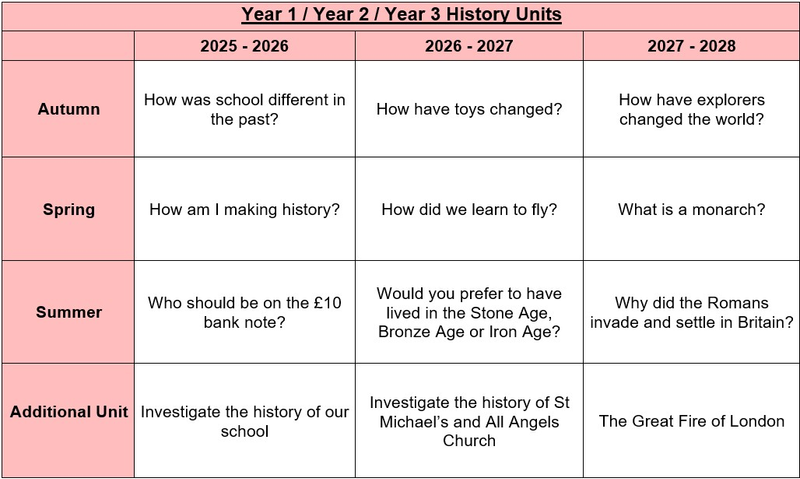
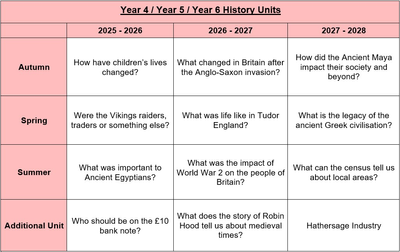
We teach history in Key Stage 1 and Key stage 2 as a three year rolling programme, ensuring that all pupils get a breadth of substantive knowledge.
Alongside our units we have a progression of disiplinary skills that each year group will focus on. This ensures that pupils develop their understanding of 'thinking like a historian'.
Timetabling
Each term we have one 6-8 week block of history which alternates with a block of Geography.
Each weekly lesson lasts for 1 hour.
Unit structure
Each unit has consistent resources to support teachers and pupils. This includes:
Key skills for the unit identified
Key knowledge for the unit identified
Very detailed lesson plans to ensure consistency in approach
Knowledge organiser for the unit
End of unit quiz
Interactive Timeline
Lesson Structure
Each lesson follows the same structure:
Recap and recall- to ensure regular retrieval practice
Attention grabber- short, engaging activity designed to hook pupils into the new learning
Main event- core part of the lesson where pupils develop their understanding of the learning objective
Wrapping up- a final reflective activity to consolidate learning.
Within each lesson, pupils are encouraged to use their knowledge organiser as a live document, which they keep adding and referring to.
SEND
We ensure that all lessons we teach are adapted to meet the individual needs of our pupils. Many of our children with specific learning needs will use the strategies they use in other lessons- such as technology to support with writing or pre-teaching to allow them to access the learning in the lesson.
Scaffolding – activities are designed with flexibility in mind, allowing for additional support or challenge where needed.
Multi-sensory approaches – lessons incorporate different elements to engage all learners.
Clear instructions and structured tasks – ensuring clarity and reducing cognitive load for pupils who benefit from additional support.
Opportunities for collaborative and independent learning – allowing pupils to work at their own pace while building confidence and independence.
By embedding adaptive teaching throughout, the scheme ensures that all pupils, regardless of their starting points, can access and succeed in their learning.
Knowledge retention
Spiral curriculum
Our History scheme incorporates a spiral curriculum model, ensuring that pupils revisit and develop their understanding of key themes and concepts as they progress. This approach allows them to make meaningful connections, reinforce their learning and achieve mastery over time.
- Revisiting key concepts – pupils encounter the same ideas multiple times throughout their education, with each revisit adding more complexity.
- Progressive depth – concepts are not just repeated but expanded upon, helping pupils to make connections and develop a richer understanding over time.
- Knowledge retention – regular exposure to key ideas strengthens memory and prevents knowledge from being forgotten.
- Skill development – pupils refine and apply their skills in different contexts, improving their ability to think critically and solve problems.
- Adaptive learning – by building on prior knowledge, the curriculum meets pupils at their current level and supports all learners, including those who need extra reinforcement and those who are ready for greater challenges.
Recap and recall
- Activates prior knowledge – helps pupils make connections between new and existing learning, reducing cognitive overload.
- Strengthens memory pathways – retrieval practice has been shown to improve retention more effectively than passive review.
- Identifies gaps in understanding – teachers can quickly assess what pupils remember and address misconceptions before introducing new content.
- Builds confidence – regular recall activities reassure pupils that they can remember key concepts, improving engagement and motivation.
- Promotes spaced learning – revisiting prior learning at regular intervals supports long-term retention, rather than cramming information into a single lesson.
Impact
How is this subject assessed?
We use quizzing to assess how pupils have retained substantive knowledge at the end of each unit and we use teacher assessment to determine if pupils have met the disciplinary objectives for their year group. We quickly address any gaps in knowledge or misconceptions by doing ‘keep up’ sessions and post-teaching sessions.
How do we know we have been successful?
Lesson observations
Data analysis
Book Looks
Pupils discussions
Teacher discussions
Staff and pupil questionnaires
How does this subject ensure readiness for next stage in education?
We endeavour to ensure that the sequence of content enables our children to progress whilst they are with us, but also to provide the building blocks necessary to develop further at secondary school and their learning journey beyond. Underlying all of this is our emphasis on leaning culture which provides the underlying principles of attitude, resilience & character.
How does this subject promote British Values & Spiritual, Moral, Social and Cultural Education?
Through our rich and varied curriculum, we ensure that our children are well equipped for life in modern Britain & have an excellent understanding of Democracy, the Rule of Law, Responsibility & Liberty, Mutual Respect plus Tolerance of those of different faiths and beliefs. Our Curriculum is driven by SMSC development and, as a result, pupils thrive – enjoying their lives, learning and wanting to make a difference for others.